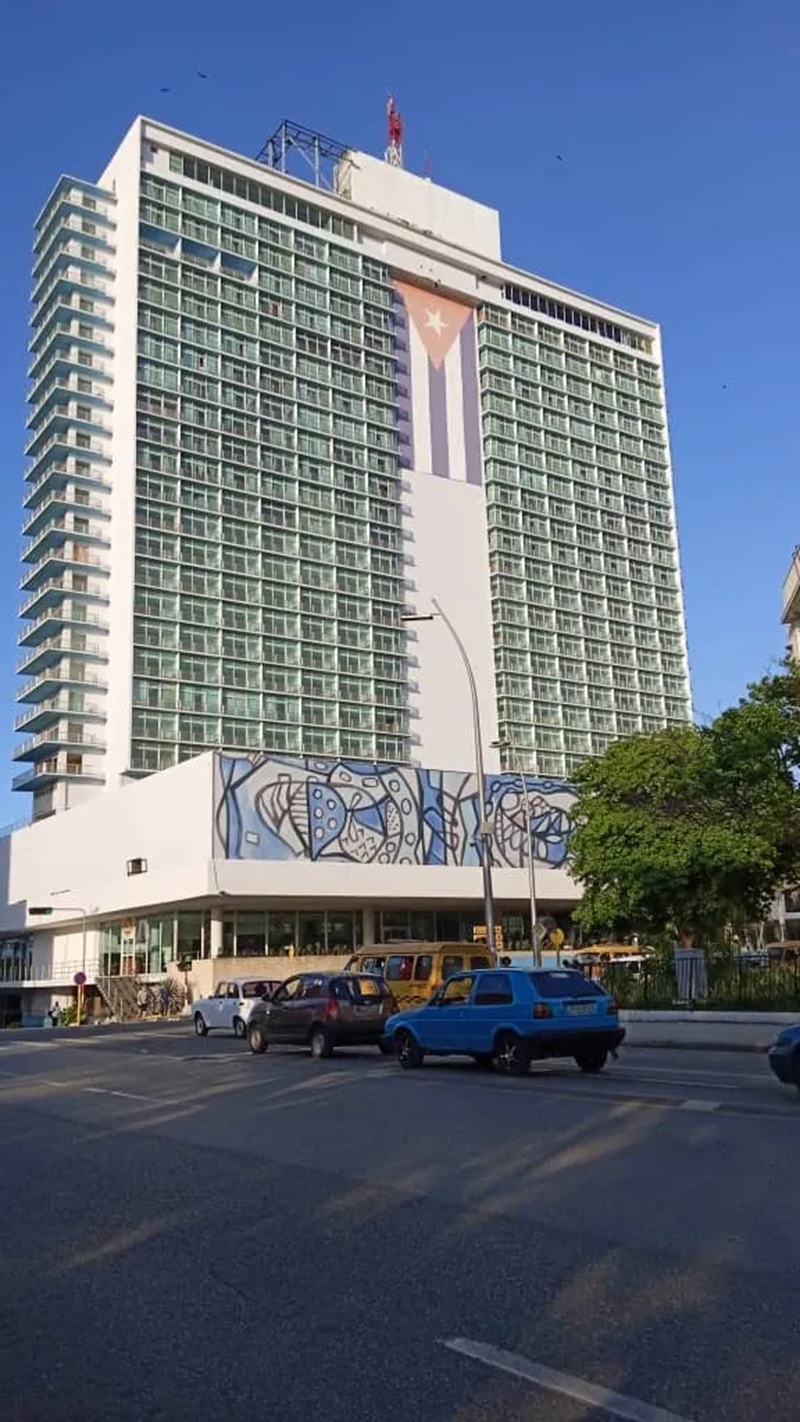
The future, hanging vertically. (Vedado, Havana, Cuba, America.)
Here’s what I’m holding this week: Acuerdo por una Cuba Libre. A transition document signed across the island and the diaspora — including me — by people who rarely get to share a table, much less a text[1].
Antes de seguir, let me say who this is for.
No escribo esto para los cubanos de adentro. To ask them to sign a letter like this, when the request comes from the outside, is not a fair ask. They are not free. If they sign, their lives will be profoundly altered by the repressive apparatus that the government has spent decades perfecting. (Perfecting, yes. They learned from the best and added innovations of their own.) The cost is not abstract. Ellos lo saben mejor que nadie.
Lo escribo para los de afuera, como yo, y para los que, unlike me, have not gone back to the country since the day they left for good. Y también para el que salió hace dieciocho or so years ago, as a kid, taken by their parents who were looking for the opportunities their country did not offer them. That person may still have Cuba inside, in their chest and in their syntax, plus a cousin or two in the island, and a Spanish that comes back slower than it used to, con un poco de esfuerzo.
Eso también es la diáspora.
I’m going to share a link to this transition document at the end of this post, along with the FAQ, and yes, I’m asking you to sign it. Consider it less a pledge of optimism than a refusal to keep outsourcing Cuba’s future to the loudest men in the room, the oldest scripts in the drawer, or the convenient fiction that “after” automatically means “better.”
But first, we need to talk about the real problem: this document is a map, and it’s missing a country.
Pushpins and Thumbtacks for Office Supplies Clipart | PNG All
Share Between Tongues
A PDF Walks into an Imagined Political Community (It Doesn’t Get the Joke)
Hay algo que incomoda en un documento como este, something that has nothing to do with what it proposes. Most of it is reasonable. Some of it is urgent. A few points will make you argue with the page; which is fine, la página no te va a responder. (Trust me, I tried.) But the discomfort isn’t in the proposals. It’s in what the document assumes. Que sabemos qué es Cuba. That we agree on what it was before. Que el horizonte hacia el que nos dirigimos is legible, shared, obvious, already drafted in the air like destiny with bullet points.
No lo es. (Surprise.)
El Acuerdo por una Cuba Libre is a transition document. Un mapa. Journalists, lawyers, doctors, artists, writers, presos políticos que ya salieron, presos políticos aún en prisión, people living in Havana and Houston and Bern and Brussels put their names to it. Eso importa. The breadth of it matters. The fact that someone in Guantánamo and someone at Yale signed the same piece of paper — que eso haya sido posible — is not nothing. (Miracles do happen. Small ones. With a lot of work.)
But a roadmap only makes sense if you know where you started. Y ahí es donde nos perdemos.
Cuba Is Not A Before/After Filter
Nostalgia is a hell of a drug.
Cuba no es el castrismo, ni tampoco su ausencia. The country did not begin in 1959, and it will not end — will not begin again — simply because the regime falls. Creer lo contrario is its own kind of exceptionalism. Shortsighted. Ahistoric. The kind of thinking that can’t produce a future because it won’t honestly evaluate the past. We’ve been doing this for sixty-something years, measuring all of Cuban history against a single revolution, the way you’d measure an entire ocean by one particularly dramatic wave. (Bad science. Worse history.)
El binario es el problema. Imperialism versus revolution. The Cuba of Batista against the Cuba of Fidel. El exilio contra la isla. We inherited this frame from the Cold War, and it has been doing damage ever since. The revolutionary government needed that binary to survive. It needed an enemy the way a campfire needs oxygen. It is considerably less clear why the rest of us still do. (Habit? Narrative convenience? The fact that binaries are easier to tweet?)
So when a document asks us to imagine a transition, la pregunta debajo de la pregunta is: transition from what, exactly? And toward what version of Cuba. ¿Cuál Cuba? ¿La de quién? The Cuba that existed before 1959 was also not paradise. (I know. Shocking.) It does, apparently, need saying.
Two Wings, Clipped Unevenly
Martí lo sabía. He called Cuba and Puerto Rico de un pájaro, las dos alas. Two wings of the same bird. Lo decía en serio: two Spanish colonies in the Caribbean, two independence movements, one shared flight toward something new. He died in 1895 before he could see what actually happened. (Quizás fue mejor así. The man had enough heartbreak.)
Lo que pasó fue 1898. The United States intervened in the Cuban war of independence against Spain — intervino, note the word — and when the smoke cleared, la guerra había sido renombrada. Ya no era la Guerra de Independencia de Cuba o la Guerra del 95. It was now the Spanish-American War. (Notice who’s missing from that title? Yeah.) Cuba had been written out of its own liberation story before the ink was dry. That move (rename the war, rename the protagonist) is an imperial party trick. Sleight of hand with bayonets.
Y la paz que siguió vino con condiciones: the Platt Amendment, which gave the United States the right to meddle in Cuban affairs whenever it saw fit. Cuba got its republic, pero nos pasaron gato por liebre. A leash dressed up as sovereignty. (Lovely gift wrapping, though.) We’ve been untangling that particular knot ever since, and anyone who tells you the revolution of 1959 has nothing to do with 1898 is selling you something. (Probably cigars. Or nostalgia. Same difference.)
Puerto Rico recibió otra cosa. No republic, no leash. Just direct annexation. Un territorio. An island of people with all the obligations of proximity to empire and few of its rights. Los Estados Unidos ni se molestaron en construir la ficción de la soberanía. ¿Para qué? Why bother with the theater when you can just own the stage? El pájaro que Martí imaginó, with its two wings beating together toward freedom, well, the United States caught it in 1898 and clipped both wings. Just unevenly.
Puerto Rico, or The Open Question
¿Y Cuba? Cuba had its revolution, sixty years later. Tenía su gran narrativa, su épica, its before-and-after, and that narrative was, in part, una respuesta real to the colonial inheritance that 1898 had left behind. To the Platt Amendment. To the distorted economy. To the American-backed governments that followed.
No se puede entender 1959 sin 1898.
The revolution knew this.
Y luego convirtió ese saber en coartada perpetua, a way to avoid accounting for what it had itself become. (There’s a specific kind of government that treats history like a credit card: it keeps charging the past to avoid paying for the present.)
Puerto Rico nunca tuvo esa narrativa. No revolution, no dictatorship, but also no decolonization. La pregunta sigue abierta. The wound stays legible because it never got a myth thick enough to cover it. (Myths are excellent scar tissue. Also excellent blindfolds.) Which means, paradoxically, that Puerto Rico might have a clearer view of the colonial question than Cuba does right now — because Cuba’s view has been filtered through the revolutionary epic for so long that it’s hard to see the frame around the painting.
Y por eso, la comparación sirve. Not because the two cases are the same (no lo son), but because they share an origin and then diverged at the exact moment when an outside power decided what each island would be allowed to become. Esa es la historia debajo de la historia. The part we keep skipping because it doesn’t fit in anyone’s epic storyline. (And we do love our epics. They make such good postcards.)
And that is what no transition document, however well-intentioned, however urgent, can fully address on its own.
It’s not a criticism of the document. It’s a description of the limits of the form. Documents fix things on paper. History is less cooperative. (Also ruder. And it doesn’t return your calls.)
El documento no va ahí. Maybe it doesn’t need to. Es un documento práctico, not a philosophical one, and practicality matters when people are hungry, in prison, leaving however they can, as soon as they can. (The body has a way of clarifying priorities.)
Bien.
Pero nosotros sí tenemos que ir ahí. We have to hold both: the urgency of now y la historia más larga; the longer history that will outlast any particular regime, and that will be waiting for us, sin prisa pero sin pausa, on the other side of whatever transition comes. (History is patient. It has nowhere else to be.)
What the Acuerdo Does Well
The Acuerdo refuses triumphalism. Doesn’t promise a Cuba libre as if *libre* were a switch you flip. Habla de justicia transicional, of archives, of the gradual reconstruction of institutions. It acknowledges that functionaries and soldiers are also human beings who will need to be integrated, no simplemente castigados. Sabe, quietly, between its numbered lines, that whatever transition comes to us will be slow, painful, incomplete.
Eso tampoco es nada. That is, genuinely, not nothing.
What it can’t do—what no document of this kind can do—is supply the political imagination the moment actually requires. “Not a transition plan”, just a “civil society campaign” that wants to “offer the opportunity for an orderly transition to democracy” is scaffolding. First steps. The kind you need before anything else can happen. It does not foresee the future. It lists what must be dismantled and leaves the architecture of what comes next to someone else, otro argumento, some harder conversation, someone’s future insomnia.
Esa conversación es la que nos toca.
A sidenote: I signed, despite the *hijos e hijas* opener, a quick reminder that the future keeps getting drafted with yesterday’s templates. (We really need new templates.) Put me down as present, nonbinary, and not optional.
Desenredar: el trabajo sucio de imaginar
Comparto este documento not as an endorsement of every clause, y no como veredicto sobre las personas que lo firmaron, many of whom I admire, some of whom I’d argue with over coffee for hours (the good kind of argument, with hand gestures), and a few of whom I suspect would argue back just as hard. Lo comparto como punto de partida. Como provocación. Evidence that something is being imagined, however imperfectly, by people who don’t have the luxury of waiting for the perfect framework.
Léanlo sabiendo lo que es: a proposal, not a promise. Un comienzo, not an answer. And read it knowing what it isn’t: a reckoning with the full weight of what Cuba carries: colonial, imperial, revolutionary, post-revolutionary, todo enredado, all of it tangled in ways that sixty-something years of dictatorship did not invent and that removing the dictatorship will not automatically undo. The rope doesn’t disappear when you stop pulling it. (If only. Would save us all a lot of time.)
El trabajo de desenredar is ours. Siempre lo fue. The document just finally gives us somewhere to stand while we do it.
Agreement for a free Cuba: FAQ
Correction / fe de erratas:
Professor Enrique Sacerio-Garí kindly emailed me to point out that the “dos alas” verse I attributed to Martí (“Cuba y Puerto Rico son / de un pájaro las dos alas”) is actually by the Puerto Rican poet and revolutionary Lola Rodríguez de Tió, from her poem “A Cuba” (1893). I love mistakes like this: they force the record to sharpen, and they return the line to the woman who wrote, who and fought for the same Antillean horizon.
[1] Hypermedia Magazine reproduce este texto de la escritora cubana Lizabel Mónica originalmente publicado en su página Between Tongues el 27 de febrero de 2026.
Diario de la invasión (V)
Después del colapso y los crímenes del colapso, será impensable llamarse de izquierdas en la cuna de la izquierda latinoamericana.
